Saturday, August 22, 2009

Alkaline Earth Metals


As a continuation of the periodic table series, this post will cover the second group of elements in the periodic table, the alkaline earth metals:
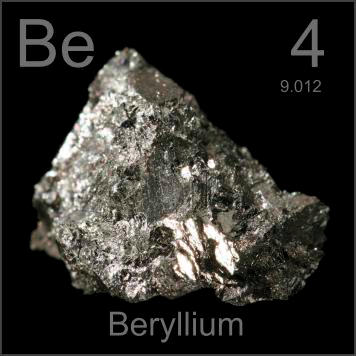
  • Beryllium, Be
  • Magnesium, Mg
  • Calcium, Ca
  • Strontium, Sr
  • Barium, Ba
  • Radium, Ra
These elements are described as "alkaline" earth metals because they form metal oxides with oxygen, which produce "alkaline" AKA basic (pH > 7) solutions when dissolved in water. One similarity among them is that they all have two electrons in their outermost shell of electrons (the ones that typically participate in chemical reactions). Consequently, they tend to ionize to a +2 cation and form salts with halogens and water, e.g., MgCl2, Ca(OH)2, etc.

Two of the alkaline earth metals are present in human bodies. Can you guess which ones?

Definitely NOT radium (it's radioactive!). Definitely not beryllium (toxic...). The two most prevalent group II elements in our bodies are magnesium and calcium. Think bones and ion pumps and enzyme cofactors...

Now, for the mnemonic:

Beryllium Metal Compounds Should Be Respected.

Tuesday, July 14, 2009

Periodic Table Series - Part I

The next few entries (18 to be exact) will be focused on the different groups in the periodic table, which is divided into groups and periods. Periods are horizontal rows, while groups are vertical columns, which often include elements with similar or at least related chemical properties. These similarities result from a variety of factors.

First, elements in the same group share the same electron configurations in the outermost "shell" or electronic sphere (the place where electrons are likely to be found) of the atoms. This means that the elements have the same number and "type" of the electrons that are most likely to participate in chemical reactions.

The first group (starting on the left and moving right) of the periodic table, Group 1, includes Hydrogen and the alkali metals, which are:
  • Lithium, Li
  • Sodium, Na
  • Potassium, K
  • Rubidium, Rb
  • Francium, Fr
Since the elements have clearly not been put into a very concise and well organized table (which has clearly not been named the "periodic table") and it is obviously not at all a simple matter to come by one of these nonexistent tables, you might want to memorize every single element in the periodic table... just for kicks.

So to aid you in this very important endeavor, I have come up with a few mnemonics. In their entirety, these learning devices will form a poem.

Herein Lies New Knowledge--Requisite Chemical Facts...

For some other useful mnemonics, check out the following link!


Wednesday, June 3, 2009

Cyanide's toxicity

Ever wonder why cyanide is so toxic? It looks pretty similar to a lot of other small anions... it has similar properties to a lot of other small anions... but it's also much more toxic than a lot of them. So what's so special about it?

All living, breathing humans (and other living, breathing prokaryotes) have an electron transport system/chain (ETS/C) in the mitochondiral membrane within their (our) cells. The main roll of this electron transport system is to--as the name implies--shuttle electrons around and in the process, make ATP. In other words, the electron transport system harnesses energy for the cells in our bodies. Without it, we can't really survive. It is part of the Kreb's cycle, which is a series of biochemical processes that break down food and convert it to energy. 

The last step carried out by the ETS involves the transfer of hydrogen from an enzyme called cytochrome oxidase to oxygen, thereby producing water. Cyanide interacts with cytochrome oxidase in such a way to prevent it from functioning normally in this last step of the ETS. As a result, aerobic metabolism slows way down but glycolysis, which produces pyruvate, continues chugging away. So pyruvate builds up in the cells and gets converted to lactic acid, thereby lowering the delicately balanced pH of the cell. Simultaneously, ATP production grinds to a halt. Without energy, our bodies stop working, i.e., we die. 

Friday, February 13, 2009

Artificially Sweet

Did you ever wonder what was actually in those artificial sweetener packets you might add to your coffee? The popular names on the market are Equal, Sweet N' Low and Splenda, although there are now many commercially available varieties.

Essentially, most of them contain some modified form of sugar that is not metabolized in the same way as standard table sugar (sucrose), thereby adding no caloric value to your diet.

Below are the chemical structures of the compounds present in the three artificial sweeteners mentioned above. Equal contains a mixture of aspartame, maltodextrin and dextrose.
Sweet N' Low is composed of saccharin, potassium bitartrate and dextrose.

Finally, Splenda simply contains a chlorinated derivative of sucrose called sucralose, in which three "OH" groups (hydroxyl groups) have been replaced by chlorine.


Tuesday, February 3, 2009

Oil 101

(Image courtesy of Creative Commons)

Ever wonder where oil comes from? Or how it got there? Or how we get it
out of there?

Oil is a "fossil fuel," which basically means it formed from fossils, i.e., the remains of plants/animals that died a
very long time ago, most of which ended up at the ocean floor. "But how," you might wonder, "did the animal/plant carcasses get turned into oil just by being dead?"

Over time, layers of sediment formed on top of the animal carcasses and eventually a very hard surface (rock) developed on top of them. Trapped between layers of hard sediment, without any oxygen (an environment in which some microorganisms thrive), the plant and animal material was eaten, metabolized and "broken down" into basic, carbon-rich material, which mixed with the surrounding sediments to form shale. But more plants and animals died, and more rock settled on top of the already present rock, causing significant pressure and heat to build up within the layers of hardness. This caused the oil to boil out in the forms of what we call "crude oil" and "natural gas," which accumulated in other, more suitable locations, such as porous rocks, where it was trapped (by less porous rocks surrounding the more porous rocks).

Although forming the oil and getting it trapped within these rocks was clearly the hard part (oh just hundreds of millions of years or so of Earth doing its thing), getting the oil out is not so easy either. First, we need to know exactly where the oil is. Of course, there are many places all over the Earth where large amounts of oil are trapped. In order to find them, geologists typically send shock waves into the Earth through layers of rock and the reflected waves are analyzed to
determine the presence or absence of oil. The reflected waves travel at different speeds, which are characteristic of the particular material through which they traveled.

Once the oil is located, oil drillers (e.g., Chevron) begin developing their plans--after having gained legal right to the land, of course--for drilling. Enter oil rig. Essentially, drill a big hole in the Earth, pump out the oil. A little bit of chemistry interwoven with this messy process, which I'll discuss in due time.

Tuesday, January 13, 2009

Jay Keasling in Newsweek

UC Berkeley Professor Jay Keasling was recently featured in Newsweek for his pioneering work on the development of a new route for the production of artemisinin, an effective antimalarial drug. Artemisinin had previously been extracted from wormwood plants, but the extraction process was time-intensive and not very efficient.

Keasling spliced wormwood genes into yeast DNA in such a way that the resulting cell would convert sugar into artemisinin. This new production method is much cheaper and more efficient than the previous method.

Even more importantly, the method will allow large scale production of artemisinin, which will be made available (and at a much lower cost) to the people who need it but could previously not afford it.