Tuesday, November 3, 2009

Quenching a THF still

Step 1: Dismantle the still. Bring the grimy distillation flask to an open space for the quenching process.

Step 2: Cool isopropanol in a large ice bath and slowly pour in the contents of the distillation flask to the stirred isopropanol. Depending on the volume of liquid/gunk, this may take anywhere from a few hours to a few days if you do it carefully and with respect for the well-being of those around you.

Step 3: Once all the pourable brown sludge has been removed from the distillation flask, add a small amount of THF to remove some residual sludge. Dump that THF solution into the isopropanol solution, which is still stirring but probably more slowly than before due to the presence of solid sludge/funk/gunk. Now the distillation flask is ready to be cleaned! First water, then 1M HCl, and voila:


Sunday, October 25, 2009

Aspartame in Your Stomach


Chemist of the Week: Karl O. Christe


Last week, our chemistry department was fortunate to receive a visit from Professor Karl Christe, who presented the Neil Bartlett Memorial Lecture. The title of his presentation was "Never Say No to a Challenge, A Lifelong Pursuit of Impossible Chemistry." It was clear by the end of his lecture why he had chosen that title. Almost every area of chemistry he has pursued would likely seem impossible to many chemists who lack the determination, work ethic and enthusiasm that has driven Professor Christe's productive research career.

Professor Christe's career began at the Technical University of Stuttgart in Germany, where he worked as a teaching assistant from 1958-1960. He completed his PhD thesis work in Frankfurt, Germany in 1961. After recognizing that he didn't fit in with the German system, he moved to the United States in search of a new job. To save money while he was looking for a job, he would sleep in the train stations as he travelled. It wasn't long before he was being offered jobs left and right by chemical companies who recognized his potential. He accepted a job in Richmond, CA as a Senior Research Chemist at Stauffer Chemical Co., where he developed some important fluorine chemistry (among other things) from 1962-1967.

From 1967-1994, Professor Christe managed the Exploratory Chemistry sector at Rocketdyne, a company in Canago Park, CA that conducted research for the development of rocket engines that use liquid propellants. Some of his major contributions to this area of chemistry include the first chemical synthesis of elemental fluorine, as well as a number of solid propellant fluorine gas generators, which are safer and easier to store than previous propellants.

After a disastrous explostion at Rocketdyne in 1994, Professor Christe left the company. Though it would typically be difficult to find a new job at the ate of 58, he had no trouble landing dual positions as a professor at the University of Southern California and as a Senior Staff Advisor at an Air Force Research Laboratory in Edwards AFB, California.

His research lab has remained small at USC. This may be due to the fact that he has been actively involved in much of his published work. It is easy to see why so many companies would have wanted to hire him when you look at his publication record and his pioneering work in such diverse areas of chemistry. Without innovative chemists like Karl Christe, chemistry would not be where it is today and we certainly wouldn't know so much about chalcogen polyazides! Let's face it--most chemists are just too scared to do chemistry that requires a leather suit, ear plugs and body shields.

Monday, August 24, 2009

Group 3: A matter of contention


Depending on who you ask, Group 3 (the third vertical column from the left) of the periodic table includes:

  • Scandium, Sc
  • Yttrium, Y
  • Lanthanum, La
  • Actinium, Ac
OR

  • Scandium, Sc
  • Yttrium, Y
  • Lanthanum-Lutetium (La-Lu) <--- "lanthanides"
  • Actinium-Lawrencium (Ac-Lr)<--- "actinides," radioactive!
OR

  • Scandium, Sc
  • Yttrium, Y
  • Lutetium, Lu
  • Lawrencium, Lr
The different classifications arise from the different logical ways of potentially arranging the elements, e.g., the first arrangement includes La and Ac, both of which are the first elements in the two rows of "f-block" elements (but both behave more like d-block metals), etc. We won't go into it anymore than that here...

The Group 3 elements, as well as the vast majority of the lanthanides and actinides (f-block), can be found hanging out together within the Earth's crust. Of the four (or 32, depending on who you're asking) group 3 elements, Yttrium has perhaps the most real world applications. Due to its ability to form compounds thatphosphoresce, it is used in the manufacture of phosphors for electronic device displays.

The mnemonics for the transition elements are more conveniently formed for periods rather than groups, since four-word sentences are a little hard to come by... So... Once we get to group 12, we will have four new mnemonics to learn!


Saturday, August 22, 2009

Alkaline Earth Metals


As a continuation of the periodic table series, this post will cover the second group of elements in the periodic table, the alkaline earth metals:
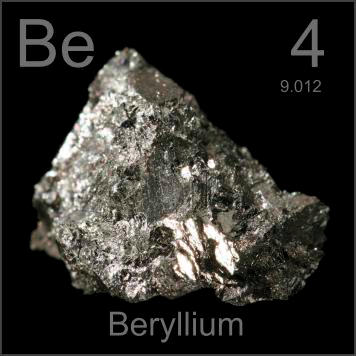
  • Beryllium, Be
  • Magnesium, Mg
  • Calcium, Ca
  • Strontium, Sr
  • Barium, Ba
  • Radium, Ra
These elements are described as "alkaline" earth metals because they form metal oxides with oxygen, which produce "alkaline" AKA basic (pH > 7) solutions when dissolved in water. One similarity among them is that they all have two electrons in their outermost shell of electrons (the ones that typically participate in chemical reactions). Consequently, they tend to ionize to a +2 cation and form salts with halogens and water, e.g., MgCl2, Ca(OH)2, etc.

Two of the alkaline earth metals are present in human bodies. Can you guess which ones?

Definitely NOT radium (it's radioactive!). Definitely not beryllium (toxic...). The two most prevalent group II elements in our bodies are magnesium and calcium. Think bones and ion pumps and enzyme cofactors...

Now, for the mnemonic:

Beryllium Metal Compounds Should Be Respected.

Tuesday, July 14, 2009

Periodic Table Series - Part I

The next few entries (18 to be exact) will be focused on the different groups in the periodic table, which is divided into groups and periods. Periods are horizontal rows, while groups are vertical columns, which often include elements with similar or at least related chemical properties. These similarities result from a variety of factors.

First, elements in the same group share the same electron configurations in the outermost "shell" or electronic sphere (the place where electrons are likely to be found) of the atoms. This means that the elements have the same number and "type" of the electrons that are most likely to participate in chemical reactions.

The first group (starting on the left and moving right) of the periodic table, Group 1, includes Hydrogen and the alkali metals, which are:
  • Lithium, Li
  • Sodium, Na
  • Potassium, K
  • Rubidium, Rb
  • Francium, Fr
Since the elements have clearly not been put into a very concise and well organized table (which has clearly not been named the "periodic table") and it is obviously not at all a simple matter to come by one of these nonexistent tables, you might want to memorize every single element in the periodic table... just for kicks.

So to aid you in this very important endeavor, I have come up with a few mnemonics. In their entirety, these learning devices will form a poem.

Herein Lies New Knowledge--Requisite Chemical Facts...

For some other useful mnemonics, check out the following link!