Tuesday, November 25, 2008

Molecule of the Week: BPO


The major ingredient in many acne treatments is benzoyl peroxide (BPO). Did you ever wonder how it works?

BPO is a member of a larger class of compounds called peroxides, which are characterized by an oxygen-oxygen single bond (you may be familiar with hydrogen peroxide, which is the simplest member of this family). A common property among peroxides is a relatively low bond dissociation energy associated with the oxygen-oxygen single bond (51 kcal/mol for hydrogen peroxide). This weak bond easily dissociates to form two radical species, which can undergo subsequent reactions with other chemicals present in the surrounding environment.

The efficacy of BPO stems mainly through its ability to induce breakdown of the outer layer(s) of skin (termed "desquamation" in the medical community). It acts by breaking up the structural proteins (keratins) in the affected area. Once absorbed by the skin, BPO is converted to benzoic acid, presumably via hydrogen abstraction from the keratins.


Friday, November 21, 2008

Photochemistry and Skin Cancer

Did you ever wonder why light from the sun (ultraviolet light) damages your skin and can cause skin cancer?

Ultraviolet (UV) radiation has wavelengths in the range of 200 nm to 300 nm. If you recall the relationship between energy and frequency, E=hv, where v=c/wavelength and c=the speed of light, then we can see that the energy of UV light can range from about 95 kcal/mol to 143 kcal/mol.

Energies in this range are sufficient to induce electronic absorption in molecules. Common organic molecules contain bonds that can be broken with the amount of energy contained in UV light.

One reaction in particular that is driven by UV light is the [2+2] cycloaddition of two thymine molecules in DNA. As you may already know, DNA is composed of two strands of connected nucleotides. Each nucleotide is made up of a nitrogen-containing heterocycle (cytosine, guanine, thymine or adenine), a sugar, and a phosphate group, which links each nucleotide to the next one in a long chain of nucleotides.
Since thymine has a double bond, it can undergo a reaction known as "cycloaddition," in which two double bonds connect with each other to form a four-membered ring (cyclobutane). As you can see below, this is a significant change! Anything that significantly alters the structure of your DNA can have drastic consequences on a number of different processes in your body.The [2+2] cycloaddition of thymine is only one of many reactions that can occur in the presence of high energy UV radiation. So wear your sunscreen!

Monday, November 10, 2008

An Introduction to Eutectic Points

Did you ever wonder why grinding two solids together sometimes produces a liquid?

Depending on the relative amounts of each component in a mixture, the melting point varies. The lowest temperature (as a function of mixture composition) at which the mixture melts is referred to as the "eutectic temperature" from the Greek word for "easily melted." The temperature and composition associated with the eutectic reaction are collectively called the "eutectic point."

(salt-less icy road image complements of Creative Commons)

Eutectic points are exploited in various ways. You are probably familiar with many of them already! For example, during the winter people often sprinkle salt (sodium chloride) over the roads in order to decrease the melting/freezing point of ice. So if the temperature outside is 0°C, the water present on the road will not freeze. The eutectic temperature of water and salt is -21.1°C (for 76.7% water and 23.3% salt), so it would have to be much colder outside for a significant amount of ice to develop on the road. Various other solids can be mixed with water to decrease its freezing point as well!

But why does mixing two solids together always result in a decreased melting/freezing point rather than an increased melting/freezing point?

It doesn't! Take, for example, a 1:1 mixture of mesitylene and hexafluorobenzene, which melts at 34°C (1). The melting point of benzene is 5°C, while the melting point of mesitylene is -44.8°C. In this case, we see an increase in the melting point on mixing two substances together!


It is believed that a complex is formed between hexafluorobenzene and mesitylene. The complex is thought to be a "Lewis base - Lewis acid" type complex, in which one component (electron-rich mesitylene) supplies charge to the other component (electron-deficient hexafluorobenzene). Hexafluorobenzene is so electron-deficient due to the strong electron-withdrawing nature of the fluorine substituent, which is the most electronegative element.

[1] Patrick, C. R.; Prosser, G. S. Nature, 1960, 187, 1021.

Saturday, October 25, 2008

Helium Balloons and Speed of Sound in a Gas


(thanks Creative Commons)

Ever wonder why inhaling helium from a balloon increased the pitch of your voice?

The pitch of your voice depends on many factors: the shape of your throat, mouth, nasal passages, etc. But most importantly, it depends on the gas present in your lungs. Under normal circumstances, the gas in your lungs is air. The speed of sound through air at 20°C is roughly 343 m/s (the temperature in your lungs is a little bit hotter, so the speed of sound through the air in your lungs is actually about 353 m/s).

What if the gas in your lungs is helium?

In general, the speed of sound, v, in a gas with molar mass M and adiabatic constant γ (which depends on the gas), at temperature T, is given by:where R is the ideal gas constant (8.314 J·K-1·mol-1).

For Helium, M is about 4 g·mol-1=0.004 kg·mol-1 and
γ=5/3, so the speed of sound at the temperature of your lungs is about 1036 m/s in Helium. This is A LOT FASTER than the speed of sound through air!

For air, which is composed of many different gases (but mostly nitrogen and oxygen), the average molar mass is about 29 g·mol-1=0.029 kg·mol-1 and γ=1.4, which accounts for the decreased speed of sound through air of about 353 m/s.

But why does this increase the pitch of your voice?

Just like any wave, the speed of a sound wave is related to the frequency and to the wavelength of the wave:

speed=frequency·wavelength

The pitch (frequency) of the sound wave that gives rise to your voice in helium increases because the speed of the wave increases, while the wavelength stays the same! So you might be wondering what your voice would sound like if you inhaled a really heavy gas, like argon or krypton... Your voice would get deeper!
But DON'T TRY IT! You might suffocate!

Green Fluorescent Protein

The 2008 Nobel Prize in Chemistry was awarded to Osamu Shimomura, Martin Chalfie and Roger Tsien for their combined discovery and application of Green Fluorescent Protein (GFP).

GFP was isolated from a Pacific Northwest jellyfish by Shimomura, who noted its absorption of blue or UV light and resultant bright green fluorescence. It is now used widely in biochemistry and biology as a tag for proteins and as a marker for gene expression. In particular, the gene that encodes GFP can be spliced into the genome (of essentially any organism, from yeast to pigs or even bunnies...) in the vicinity of a gene that encodes a protein of interest. The expression of GFP is then linked to the expression of the protein under investigation. Whenever and wherever that protein is expressed is then easy to monitor because GFP is produced simultaneously!

(Image from Creative Commons)

You can probably imagine some of the other fascinating potential applications of GFP, ranging from tracking cancer metastasis and angiogensis in mice, to measuring calcium concentration in vivo.

Tuesday, October 21, 2008

Chemistry Quote of the Day

"Synthetic efficiency is in reality limited only by scientific principles and the boundary conditions of our planet, rather than by economical and biological factors. Chemists are thus encouraged to develop truly efficient processes at all costs, and the key phrase in this context should be 'Practical Elegance'."

-Ryoji Noyori, Green Chem., 2003, 5, G37-G39

Monday, October 13, 2008

LCD's, Color, and Pixels!

Did you ever wonder what a "pixel" really is?

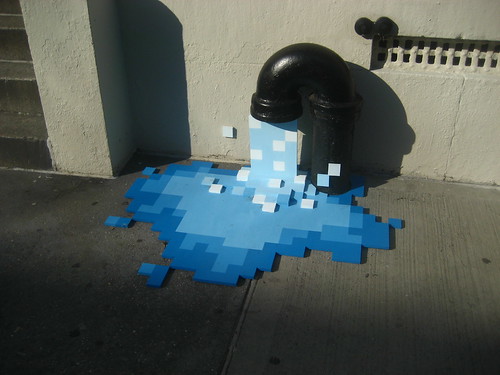
(Pixel spout from Creative Commons)

As promised, today we're going to learn about how L
CD's have been developed to produce a vast array of different colors in different positions of your computer screen (or for those more technologically advanced readers, your TV screen!).

Pixel stands for "Picture Element" and it represents one of thousands or millions of points on your graphics display, which are ordered in rows and columns. If you were to zoom in on your computer screen A LOT, you would be able to see a single pixel, but since the screen you are viewing now is so zoomed out and there are so many pixels, you cannot tell that they are just tiny dots of color. The number of colors possible for each pixel is determined by the number of bits (click the link to learn about information theory), e.g., 10 bits allows for 2^10=1024 different colors possible for that pixel, although most pixels are 8-bit, which is more than enough.

If you have a color (rather than black or white) computer screen, then each pixel is made from three dots (blue, green and red).
There are two types of LCD matrices: passive and active.

In a passive-matrix LCD, a grid transfers charge to the pixels. The grid consists of two glass sheets, one lined with columns and one lined with rows of a conducting material. The rows and/or columns are hooked up to electric circuits, which control the allocation of charge. Between the two glass sheets, as mentioned in the previous entry, is a layer of LC's. And on the outsides of each sheet of glass is a polarizing film.

In order to light up a pixel, charge is transferred down a column on one of the glass sheets. When the charge reaches a point on the other glass sheet that is grounded, the pixel at that intersection will light up in response to the untwisting (see previous entry) of the LC's at that point, and voila--color!

Have you ever noticed a trail behind the arrow on your screen when you moved it around rapidly? That trail results from the inadvertent untwisting of LC's in the immediate vicinity of the pixel of interest!

Now what about active-matrix LCD's?

Active-matrix LCD's use a glass sheet, much like the ones used in passive-matrix LCD's, but instead of columns or rows, the active-matrix glass sheet consists of a matrix of transistors and capacitors. In order to charge a pixel, the appropriate row is turned on and charge is transferred down the appropriate column. In this way, the capacitor at the specified pixel gets charged. And capacitors are pretty good at holding on to charge, so the pixel stays lit for as long as you like. Depending on how much charge is transferred to the pixel, we can vary the amount of light/color that is produced, thereby displaying the elaborate set of colors and shapes that you currently see on your screen!