Tuesday, January 13, 2009

Jay Keasling in Newsweek

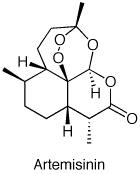
UC Berkeley Professor Jay Keasling was recently featured in Newsweek for his pioneering work on the development of a new route for the production of artemisinin, an effective antimalarial drug. Artemisinin had previously been extracted from wormwood plants, but the extraction process was time-intensive and not very efficient.

Keasling spliced wormwood genes into yeast DNA in such a way that the resulting cell would convert sugar into artemisinin. This new production method is much cheaper and more efficient than the previous method.

Even more importantly, the method will allow large scale production of artemisinin, which will be made available (and at a much lower cost) to the people who need it but could previously not afford it.

Monday, December 22, 2008

Cold Nuclear Fusion - Fact or Fiction?

Surely you have heard of the supposed "cold fusion," first reported in 1989 at a press conference (super sketch!) by Drs. Stanley Pons and Martin Fleischmann at the University of Utah. But did you ever wonder what it was? Or whether it actually works?

Nuclear fusion refers to the process by which multiple nuclei of similarly charged atoms unite to form a heavier atom and typically A LOT OF ENERGY--with the exception of atoms heavier than iron, which actually absorb energy on fusion. Due to the typically high energy output, nuclear fusion could potentially provide a useful source of energy for our growing--and increasingly demanding--global population. One significant problem is that the process typically occurs only at ridiculously high temperatures, such as those found in the Sun or in a hydrogen bomb. Not surprisingly, scientists have long been interested in designing cheap, safe and effective methods for controlled fusion to produce usable energy.

Pons and Fleischman described a system containing deuterated water (D2O), two palladium electrodes, and a current running through the electrodes. They claimed that the current caused the palladium electrodes to absorb deuterium atoms, which were then forced so closely together that they underwent nuclear fusion to produce neutrons and energy in the form of heat: "...fusion occurs, out of that comes one or two new elements of less mass, and the difference is the energy that comes out. And that then would boil water, essentially. And when you boil water, you can make steam. And when you make steam, you can drive a turbine. And if you can drive a turbine, you can create electricity..." (watch the press conference).

The two scientists concluded that cold fusion had occurred based on the results of a calorimetric experiment that showed a 4:1 ratio of heat put into the experiment versus heat released. They also analyzed the gas released by the reaction by mass spectrometry and observed the presence of tritium. Finally, they claimed to have captured the ejected neutrons from the reaction vessel with water, and the water was found to emit gamma rays of a characteristic wavelength.

Skeptical scientists immediately tried to reproduce a similar cold fusion and they found largely inconsistent results. Many suggested that the heat Pons and Fleischman observed was produced either by the current or by reactions in the water.


Even to this day, many scientists continue to pursue cold fusion as a viable energy alternative. Until someone disproves the process, it will remain elusive--maybe fact, maybe fiction. But the lesson remains: reputable, peer-reviewed scientific journals are a much more reliable medium than a press conference through which to share scientific results.
Wednesday, December 3, 2008

Chemist of the Day: John D. Roberts

Born June 9, 1918 (Yes, he's 90 and still going strong) John D. Roberts got his BA in 1941 and his PhD in 1944 from UCLA. After working as a professor at MIT, Roberts moved to Cal Tech, where he has remained ever since. He has made important contributions to physical organic chemistry--specifically in the areas of nuclear magnetic resonance spectroscopy, resonance in organic chemistry, structural determination, and kinetics.

He has written books on various topics in a manner that is quite easy to read, even if you don't know much about chemistry or anything for that matter. This is one of the many reasons why he has been selected as the chemist of the day--not only has he made significant advances in diverse areas of chemistry, he has very effectively developed and documented these ideas for new generations of chemists and he continues to serve as an inspiration to us all.

Below is a list of some of his important books, all of which I highly recommend to anyone interested in organic chemistry.

Roberts, J.D. : Nuclear Magnetic Resonance. Mc-Graw-Hill, New York, 1959.

Roberts, J.D. :
Notes on Molecular Orbital Calculations. W. A. Benjamin, New York, 1961. [one of my particular favorites!]

Roberts, J.D. : An Introduction to the Analysis of Spin-Spin Splittings in High Resolution Nuclear Magnetic Resonance Spectra. W. A. Benjamin, New York, 1961.

Roberts, J.D., Caserio, M. : Basic Principles of Organic Chemistry. W. A. Benjamin, New York, 1977.

Roberts, J.D. :
At the Right Place at the Right Time. ACS-Books, Amer. Chem. Soc., 1990.

Roberts, J.D. : ABC's of FT-NMR. University Science Books, 2000.


Tuesday, November 25, 2008

Molecule of the Week: BPO


The major ingredient in many acne treatments is benzoyl peroxide (BPO). Did you ever wonder how it works?

BPO is a member of a larger class of compounds called peroxides, which are characterized by an oxygen-oxygen single bond (you may be familiar with hydrogen peroxide, which is the simplest member of this family). A common property among peroxides is a relatively low bond dissociation energy associated with the oxygen-oxygen single bond (51 kcal/mol for hydrogen peroxide). This weak bond easily dissociates to form two radical species, which can undergo subsequent reactions with other chemicals present in the surrounding environment.

The efficacy of BPO stems mainly through its ability to induce breakdown of the outer layer(s) of skin (termed "desquamation" in the medical community). It acts by breaking up the structural proteins (keratins) in the affected area. Once absorbed by the skin, BPO is converted to benzoic acid, presumably via hydrogen abstraction from the keratins.


Friday, November 21, 2008

Photochemistry and Skin Cancer

Did you ever wonder why light from the sun (ultraviolet light) damages your skin and can cause skin cancer?

Ultraviolet (UV) radiation has wavelengths in the range of 200 nm to 300 nm. If you recall the relationship between energy and frequency, E=hv, where v=c/wavelength and c=the speed of light, then we can see that the energy of UV light can range from about 95 kcal/mol to 143 kcal/mol.

Energies in this range are sufficient to induce electronic absorption in molecules. Common organic molecules contain bonds that can be broken with the amount of energy contained in UV light.

One reaction in particular that is driven by UV light is the [2+2] cycloaddition of two thymine molecules in DNA. As you may already know, DNA is composed of two strands of connected nucleotides. Each nucleotide is made up of a nitrogen-containing heterocycle (cytosine, guanine, thymine or adenine), a sugar, and a phosphate group, which links each nucleotide to the next one in a long chain of nucleotides.
Since thymine has a double bond, it can undergo a reaction known as "cycloaddition," in which two double bonds connect with each other to form a four-membered ring (cyclobutane). As you can see below, this is a significant change! Anything that significantly alters the structure of your DNA can have drastic consequences on a number of different processes in your body.The [2+2] cycloaddition of thymine is only one of many reactions that can occur in the presence of high energy UV radiation. So wear your sunscreen!

Monday, November 10, 2008

An Introduction to Eutectic Points

Did you ever wonder why grinding two solids together sometimes produces a liquid?

Depending on the relative amounts of each component in a mixture, the melting point varies. The lowest temperature (as a function of mixture composition) at which the mixture melts is referred to as the "eutectic temperature" from the Greek word for "easily melted." The temperature and composition associated with the eutectic reaction are collectively called the "eutectic point."

(salt-less icy road image complements of Creative Commons)

Eutectic points are exploited in various ways. You are probably familiar with many of them already! For example, during the winter people often sprinkle salt (sodium chloride) over the roads in order to decrease the melting/freezing point of ice. So if the temperature outside is 0°C, the water present on the road will not freeze. The eutectic temperature of water and salt is -21.1°C (for 76.7% water and 23.3% salt), so it would have to be much colder outside for a significant amount of ice to develop on the road. Various other solids can be mixed with water to decrease its freezing point as well!

But why does mixing two solids together always result in a decreased melting/freezing point rather than an increased melting/freezing point?

It doesn't! Take, for example, a 1:1 mixture of mesitylene and hexafluorobenzene, which melts at 34°C (1). The melting point of benzene is 5°C, while the melting point of mesitylene is -44.8°C. In this case, we see an increase in the melting point on mixing two substances together!


It is believed that a complex is formed between hexafluorobenzene and mesitylene. The complex is thought to be a "Lewis base - Lewis acid" type complex, in which one component (electron-rich mesitylene) supplies charge to the other component (electron-deficient hexafluorobenzene). Hexafluorobenzene is so electron-deficient due to the strong electron-withdrawing nature of the fluorine substituent, which is the most electronegative element.

[1] Patrick, C. R.; Prosser, G. S. Nature, 1960, 187, 1021.

Saturday, October 25, 2008

Helium Balloons and Speed of Sound in a Gas


(thanks Creative Commons)

Ever wonder why inhaling helium from a balloon increased the pitch of your voice?

The pitch of your voice depends on many factors: the shape of your throat, mouth, nasal passages, etc. But most importantly, it depends on the gas present in your lungs. Under normal circumstances, the gas in your lungs is air. The speed of sound through air at 20°C is roughly 343 m/s (the temperature in your lungs is a little bit hotter, so the speed of sound through the air in your lungs is actually about 353 m/s).

What if the gas in your lungs is helium?

In general, the speed of sound, v, in a gas with molar mass M and adiabatic constant γ (which depends on the gas), at temperature T, is given by:where R is the ideal gas constant (8.314 J·K-1·mol-1).

For Helium, M is about 4 g·mol-1=0.004 kg·mol-1 and
γ=5/3, so the speed of sound at the temperature of your lungs is about 1036 m/s in Helium. This is A LOT FASTER than the speed of sound through air!

For air, which is composed of many different gases (but mostly nitrogen and oxygen), the average molar mass is about 29 g·mol-1=0.029 kg·mol-1 and γ=1.4, which accounts for the decreased speed of sound through air of about 353 m/s.

But why does this increase the pitch of your voice?

Just like any wave, the speed of a sound wave is related to the frequency and to the wavelength of the wave:

speed=frequency·wavelength

The pitch (frequency) of the sound wave that gives rise to your voice in helium increases because the speed of the wave increases, while the wavelength stays the same! So you might be wondering what your voice would sound like if you inhaled a really heavy gas, like argon or krypton... Your voice would get deeper!
But DON'T TRY IT! You might suffocate!